
Learn Chinese Through Stories
Forget flashcards and grammar drills. The fastest path to Mandarin fluency is doing what your brain was built for — absorbing language through compelling narratives.
The problem with traditional methods
Why Most People Quit Chinese
The average Chinese learner abandons after 6 months. Not because the language is too hard — but because the method is wrong.
Flashcards & Anki
Vocabulary learned in isolation is forgotten 60–80% faster than words encountered in context. You recognise cards; you can't read text.
Grammar Textbooks
Grammar-translation produces readers who can parse sentences but freeze in real conversation, because rules ≠ internalised patterns.
Rote Tone Drills
Drilling tones in isolation ignores how tones shift in connected speech. Listeners need rhythmic context — which only continuous reading provides.
Language acquisition research
Your Brain Is a Story Machine
Decades of linguistics research point to one conclusion: we acquire language by understanding messages, not by memorising rules.
Better Retention
Words encountered in authentic context are retained 2–3× longer than identically-reviewed isolated flashcards.
Encounters to Acquire
A learner needs 6–20 meaningful encounters with a word to internalise it. Stories naturally re-surface words.
Coverage Threshold
Readers need to understand 98% of surrounding words to infer meaning — i.e. rich context is key.
Krashen's Comprehensible Input Hypothesis
Professor Stephen Krashen's research showed that language is acquired by encountering input that is understandable but slightly challenging (i + 1). Graded stories are the most practical implementation of this principle.
Method comparison
Story Reading Outperforms Every Alternative
Estimated vocabulary retention after 4 weeks (composite of Nation, 2001; Waring & Takaki, 2003; and Webb, 2007)
Note: Percentages are illustrative estimates drawn from peer-reviewed research.
How it works
From HSK 1 to Full Fluency
ReadChinese is built around the comprehensible input cycle. Every feature exists to keep you reading at the edge of your ability.
Pick a story at your level
Stories are graded HSK 1–7. Start where you are comfortable, or use our quick level assessment. Each story is 100–400 words.
Tap any word for instant context
Every character is annotated. Tap a word to see pinyin, definition, HSK level, and example usage — without leaving the story.
Listen and read simultaneously
Professional native-speaker audio narration plays in sync with the text. Words highlight as they are spoken — training both senses.
Reinforce with a comprehension quiz
Each story ends with a short multiple-choice quiz. This active recall step significantly boosts long-term retention.
Track your daily streak
Your streak and story history keep you accountable. Consistent daily reading is more effective than occasional longer sessions.
Graduate to harder stories
As your vocabulary grows, harder stories become comprehensible. The library grows with you — there's always a story at your i+1.
Inside the app
Every Feature Serves One Goal: Keep You Reading
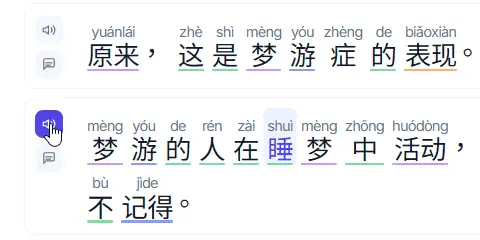
Audio Sync
Words light up as the narrator speaks
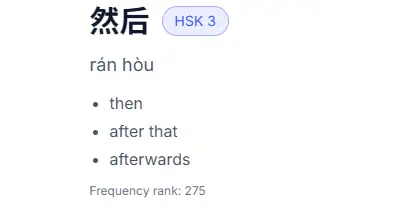
Word Explorer
Pinyin, meaning, HSK level in one tap
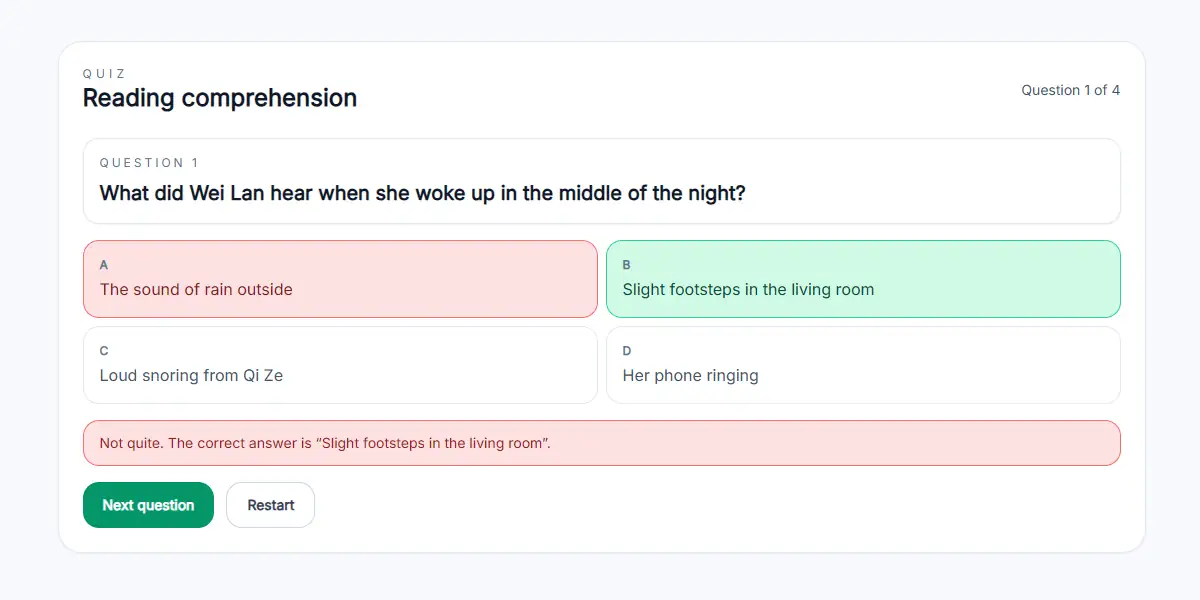
Comprehension Quiz
Short recall test after each story
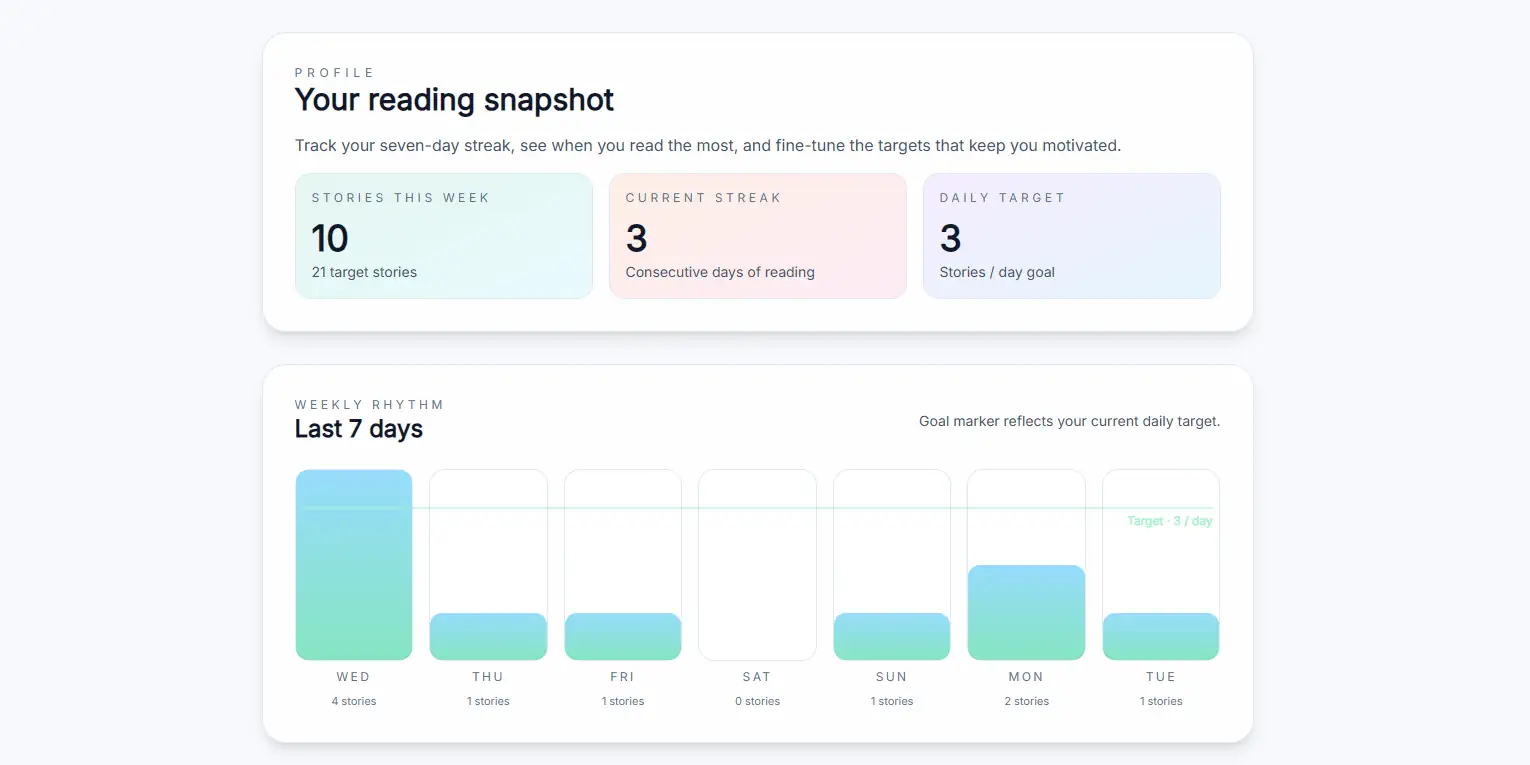
Progress & Streaks
Daily reading habit tracker
The Logographic Challenge
Especially Powerful for Mandarin
Chinese isn't just another language. The gap between "knowing a word" and "reading naturally" is wider due to the nature of characters.
Characters in context
Chinese has ~2,500 characters in everyday use. Trying to learn them in isolation is overwhelming. In stories, characters repeat in meaningful combinations — your brain maps sound, meaning, and shape simultaneously.
Tones through rhythm
Mandarin tones are easier to acquire through the natural rhythm of sentences than through isolated drill. Reading with audio builds tone intuition the same way native speakers develop it — through massive exposure.
Grammar through patterns
Chinese grammar is positional — no inflections, no conjugations. The fastest way to internalise word order is to see patterns repeated across dozens of sentences in real contexts.
Cultural fluency
Language is culture. Stories set in China naturally expose you to cultural references, idioms, and social dynamics that textbooks ignore — giving you real communicative competence.
The Research Foundation
This Isn't a Theory. It's Been Proven.
Krashen, S. (1985)
The Input Hypothesis
Foundational theory: language is acquired through comprehensible input, not explicit instruction.
Nation, I.S.P. (2001)
Learning Vocabulary
Contextualised vocabulary learning yields 2–3× better long-term retention.
Waring & Takaki (2003)
Vocabulary from Reading
Extensive reading produces significant vocabulary gains with minimal conscious effort.
Webb, S. (2007)
Effects of Repetition
Words require 6–20 exposures in context to be fully acquired into productive vocabulary.
Mason & Krashen (1997)
Extensive Reading
Extensive reading outperformed traditional instruction on all standardised measures.
Elley (1991)
Acquiring Literacy
Story-based reading programs produced faster gains than intensive skills-based approaches.
Ready to Start Reading?
Stop memorizing word lists. Join thousands of learners mastering Chinese through the stories they love.
Free to start • No account required to read